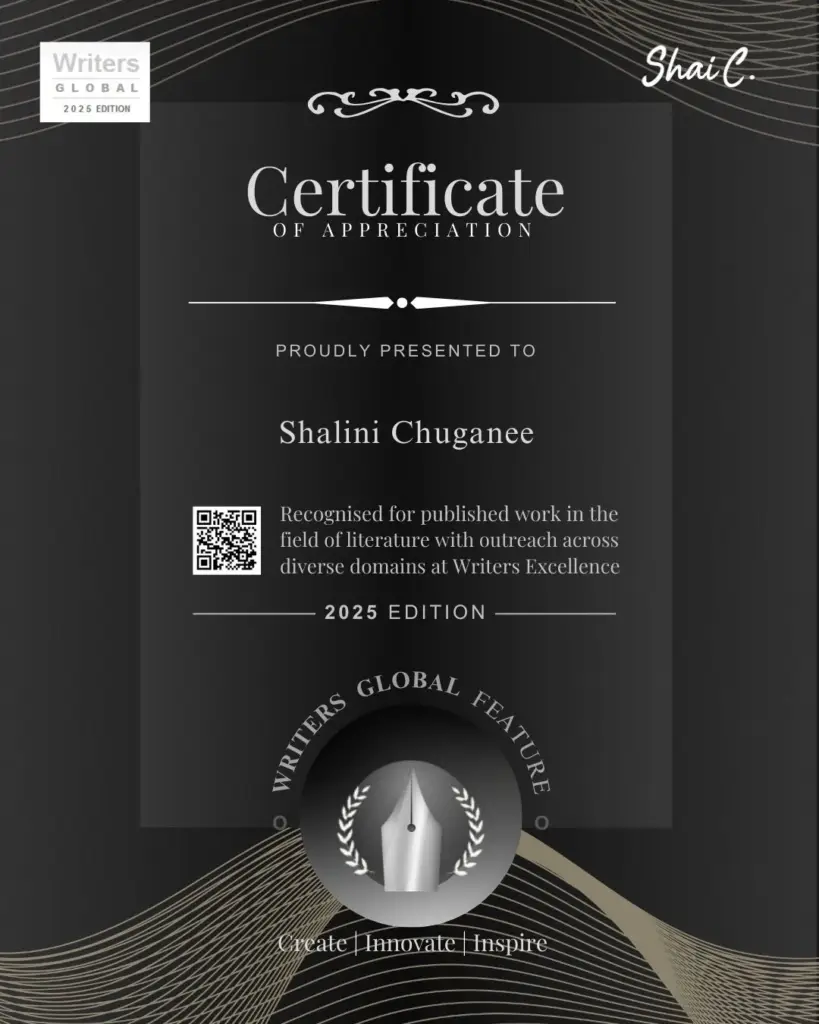
A career is noisy at times–rolls, achievements, applause. And moments which come unannounced, but fall deep. Being a recognized writer by Writers Global 2025 was one of these events to me. Not because it had become successful, but because it had recognized something much more personal: a body of work which had been based on truth, healing, and lived experience.
Since emotional health, intimacy, and trauma recovery are the focus areas of my work, there has never been a need to be recognized. It has always been about assisting the individuals, couples, families in making meaning out of the pain and get out of it with dignity. And still, when such a work is perceived and appreciated in the world, it is a chance to stop, look back and repent.
This acknowledgment has come when the discussion of betrayal, trust, and relationships is more than ever, particularly in places such as New York, where ambition, pressure, and connection are all complexly present together.
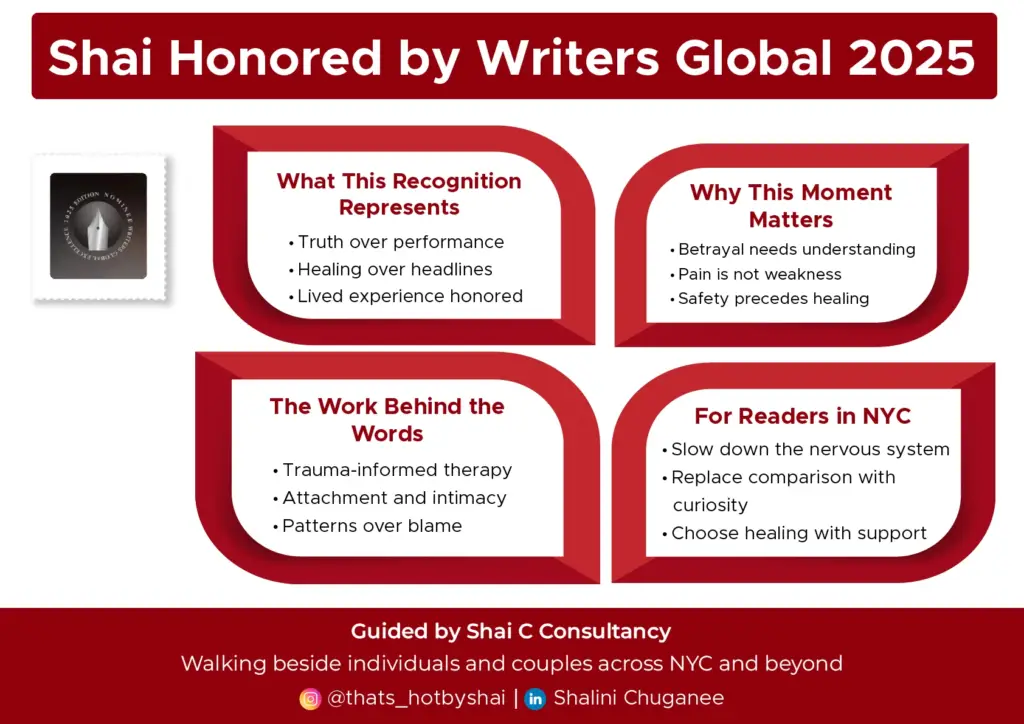
The significance of this moment–and particularly to NYC readers.
A recent frenzy of media and social platform talk about betrayal fervor erupted in recent weeks, after a news broadcasted debate with major social personalities. The question discussed was not new, but it demanded an answer: is emotional betrayal more hurtful than the physical one?
Since I am a person whose work was just published in Mumbai Mirror in an article titled The Truth About Betrayal, I simply felt that I have to do something not to create noise, but to create understanding.
What I observe across many cases of my work with clients in NYC, the USA, India, and other countries is as follows: there is less confusion of what betrayal is and more misconception about how to comprehend it as something not to be ashamed of.
Social media is successful on binaries. Therapy does not.
Clinically and humanly, betrayal has nothing to do with hierarchy of pain. It is also about knowing where trust broke, why emotional safety vanished and what has to be fixed.
Here relationship therapy is necessary, not to control damage, but to provide a platform of open-minded reckoning.
Getting rid of labels: what disruption is betrayal.
The fact that betrayal is upsetting, in part, is because it not only upsets a relationship but also causes havoc with the nervous system.
As a Certified Cognitive Behavioral Therapist, I frequently explain this to those clients who think they are crazy since they read about betrayal. It is not a weakness that you are reacting hypervigilance, anxious, numb, obsessively. It is your brain reacting to perceived danger.
Regardless of whether it was an emotional or a physical betrayal the body reacts as having lost its safety.
We are not in a hurry to forgive or find solutions in trauma therapy. We take slow enough to discern how the body and the mind are processing that which happened. The process of healing starts with the people ceasing to judge their reactions and start to listen to them.
It is specifically applicable to the NYC professionals, caregivers, and high-functioning individuals who are accustomed to powering through pain instead of dealing with it.
Why emotional betrayal is so non-oppressive–but so painful.
Numerous customers report that emotional infidelity was more difficult to communicate about than extramarital affairs. There were no facts to refer to, no facts to refer to, but an increasing feeling of displacement.
Late-night conversations. Private emotional worlds. Collective weaknesses diverted elsewhere.
The bond is usually copied away by emotional betrayal. And since it has no distinct social scripts, individuals experience uncertainness regarding their entitlement to suffer.
What I can explain to my work as a sex coach and therapist is as the following: pain does not need permission.
Attachment bond is influenced when intimacy is no longer on the major relationship. That is real. It is often the first step to healing to name it, and not to downplay it.
Why is analogy hardly a solution to couples?
Comparison is one of the pitfalls that couples get into following betrayal. Which betrayal was worse? Who hurt more? Who failed first?
Such questions will hardly bring anyone forward.
In my case of CBT Couples Counseling Services, the turning point is when the couples begin to change their comparison to curiosity. Not “Who is more wrong?” but “How did we get here?”
To other couples, betrayal can result in a point of separation that brings increased frankness, more fences, and a reawakening of intimacy. To some people it explains the fact that the relationship has ended as it should.
The two results involve bravery. Both require support.
That is why individuals seeking the best couple counselor or best couple therapy in USA are not usually seeking the fixes but safety, structure and one that appreciates complexity.
My path to the clinical field up to the writing of my book.
The years of clinical practice and my personal experience of overcoming emotional pain, self-abandonment and recovery gave birth to my book, Love That Was Meant for Me.
Clients in NYC and all over the world continued to pose the same questions:
- Where did I copy the same designs?
- Why does love feel unsafe?
- Is something wrong with me?
The book is not about blame. It is about awareness. It integrates CBT, attachment theory and thoughts on intimacy into a guide to self-belief and relationship clarity.
To continue reading this work, the book can be read this way:
https://www.amazon.in/dp/8199171219
It was another way of selecting myself–and selecting transparency instead of perfection–to write it.
What Writers Global 2025 means to me.
The fact that I am honored by Writers Global 2025 is not a title. It is acknowledgement of work that rests uneasily as opposed to dramatising it.
It confirms that there is a value in the dialogue of betrayal, trauma therapy, sexuality and emotional wellness–cultures and geographies.
More to the point, it is a reminder that when the stories are based on the truth, they touch on a much wider place of where they are being written.
Closing reflection
This moment of recognition is deeply humbling. But its real value lies in what it can offer others – the permission to slow down, to seek help, and to move beyond the noise of online debates toward meaningful healing.
Trust is not rebuilt through labels. It is rebuilt through consistency, compassion, and courage.
And if my work – through writing, therapy, or public dialogue – helps even one person feel less alone in that process, then this recognition has already fulfilled its purpose.
For more reflections and conversations, you can connect with me through my social channels and ongoing writing.