In New York City, restaurants are rarely just about food. They are about status, romance, connection, networking. Tables are full. Laughter spills into the street. Reservations are hard to get.
And yet, one of the most transformative acts I encourage my clients to practice is this:
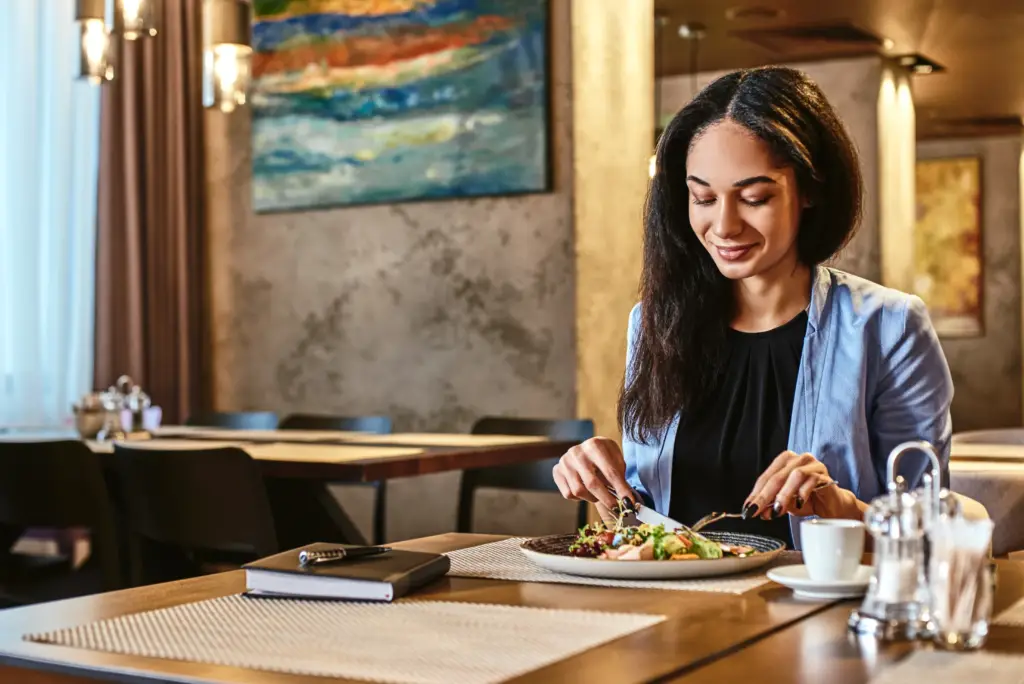
Take yourself out to dinner. Alone.
Not because you have no one.
But because you are someone.
As someone who works in Relationship therapy and Trauma therapy with clients across NYC, the USA, and internationally, I have noticed something important: many people can lead meetings confidently, travel solo for work, and make bold professional decisions — but feel deeply uncomfortable sitting alone at a restaurant table.
That discomfort tells a story.
Why Does Solo Dining Feel So Uncomfortable?
When you walk into a restaurant alone, your nervous system may activate. You may feel watched. Judged. Exposed.
These reactions are rarely about the room. They are about internal narratives.
Many of us learned that being alone meant being unwanted. That visibility required validation. That shared experiences determined value.
Through Help with emotional trauma, I help clients identify how early conditioning influences present discomfort. If belonging once depended on approval, solitude can feel threatening.
But choosing to sit alone is not isolation.
It is autonomy.
Is Solo Dining a Form of Emotional Independence?
Yes — when it is intentional.
Solo dining is not about proving you do not need anyone. It is about demonstrating that your presence is enough.
In my work offering Emotional regulation therapy in NYC, I teach clients to notice what surfaces when they sit alone in public:
- Do you reach for your phone immediately?
- Do you feel the urge to appear busy?
- Do you rush the meal?
These small behaviors reveal larger patterns. Can you sit with yourself without distraction? Can you enjoy your own company without performance?
Confidence is not loud. It is regulated.
What Does Solo Dining Reveal About Self-Worth?
Self-worth shows up in the details.
Do you reserve the restaurant you truly want or the one that feels “appropriate” to justify being alone?
Do you order what you desire or what feels safe?
These may seem minor, but they reflect internal permission.
As a Certified Cognitive Behavioral Therapist, I often explore the thoughts that arise during moments of independence:
- “People must think I got stood up.”
- “This is embarrassing.”
- “I shouldn’t be doing this alone.”
Through structured work similar to CBT Couples Counseling Services, we challenge distorted narratives that equate solitude with deficiency.
Sitting alone at a beautifully set table in NYC can become a quiet declaration: I am not waiting to be chosen.
I choose myself.
How Does Solo Dining Impact Romantic Relationships?
Interestingly, individuals who practice intentional solitude often show up differently in partnership.
They do not cling to connection out of fear.
They do not tolerate disrespect simply to avoid being alone.
Some clients initially seek the best couple therapy in USA because their relationships feel unstable. Often, part of the work involves strengthening their relationship with themselves first.
When you are comfortable dining alone, traveling alone, existing alone, you no longer approach relationships from scarcity.
You approach them from alignment.
Is Taking Yourself Out Really That Radical?
In a culture that constantly pairs experiences with companionship, yes.
Especially for women.
Women are often socialized to prioritize relational roles — partner, friend, caregiver. Public solitude can feel like stepping outside expectation.
As a Family counselor in NYC, I see how generational narratives shape this discomfort. Some women were taught that being seen alone signals failure. Others were taught that their value increases when they are accompanied.
Breaking that narrative requires practice.
Solo dining is practice.
What Does It Mean for Emotional Leadership?
As an Emotionology practitioner USA, I believe emotional leadership begins with self-presence.
Can you sit with your thoughts without rushing?
Can you observe discomfort without fleeing it?
Can you enjoy beauty without needing it to be witnessed?
When you take yourself out to dinner, to a museum, to a café, you strengthen emotional steadiness.
This steadiness impacts everything: how you date, how you negotiate, how you set boundaries.
How Can You Start Practicing This?
Start small.
Choose a weekday lunch. Leave your headphones at home. Notice your breathing when you enter.
If anxiety rises, do not shame yourself. That reaction is data.
Over time, the activation softens.
What remains is quiet confidence.
Not the performative kind. The internal kind.
A Grounded Closing Reflection
If you are in NYC and have hesitated to book that table for one, consider this your invitation.
Not because you have something to prove.
But because your presence deserves celebration.
Solo dining is not about detachment. It is about dignity.
It is about learning that companionship is beautiful — but not required for worth.
For continued reflections on emotional independence, trauma recovery, and relational clarity, you can follow my work on Instagram and Facebook, where I share grounded insights beyond the therapy room.
Taking yourself out is not a lonely act.
It is a confident one.
And confidence, when rooted in self-respect, changes the way you show up everywhere else.
To continue reflecting on relationships, emotional healing, and trauma-informed care, you can follow my work on social platforms.
Get more thoughts and healing resources and talk about emotional intimacy and empowerment with me on Instagram and on Youtube.